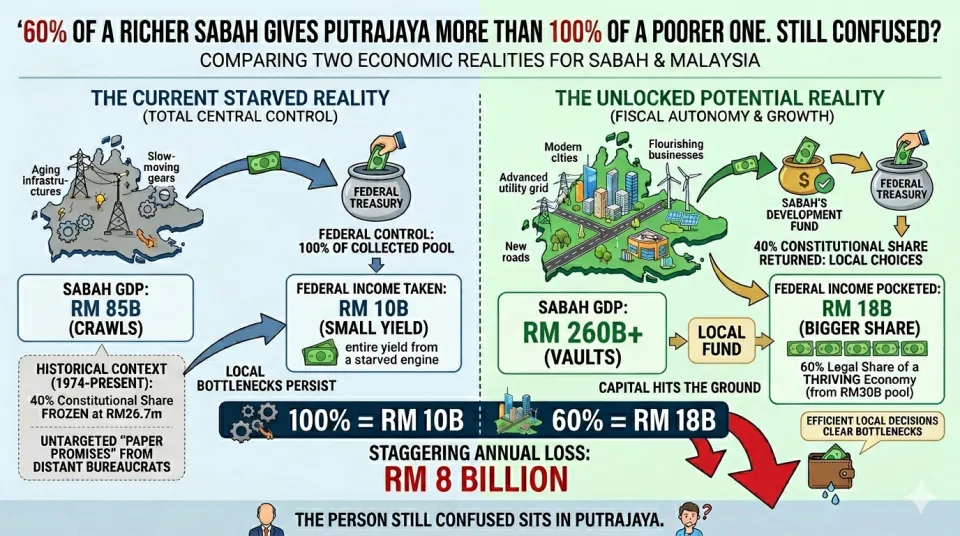
The federal treasury loses RM8 billion in revenue every single year because it preferred total control over massive growth.By insisting on 100 per cent control of a starved economy, Putrajaya takes home RM10 billion. By settling for its legal 60 per cent share of a thriving Sabah, it would pocket RM18 billion annually.
This compounding error began in 1974, when administrative manoeuvres froze Sabah's 40 per cent constitutional cash handout at a flat RM26.7 million. This is what the central government’s “effort” to retain 100 per cent of the state's revenue as federal income.
To a distant bureaucrat, keeping the entire collection pool looked like an easy win because conventional ledger logic says 100% is the maximum possible haul.
Capturing the entire revenue pool flattened Sabah's long-term growth. In 1974, Sabah's economy was actually larger than Sarawak's. (Est. RM2.2b vs RM1.9b)
Since then, Sarawak protected up to 90 per cent of its domestic sector, shielded from being absorbed by the federal government, to vault to a RM155 billion economy. Meanwhile, stripped of fiscal autonomy, Sabah crawls at RM85 billion.
Had Sabah retained its 40 per cent cash handout to modernise utility grids and fund local infrastructure, its GDP would easily surpass RM260 billion today.
The core problem is not a total lack of federal funding. Putrajaya consistently grants development budget allocations to the state, while not up to par. However, those billions represent paper promises rather than capital truly hitting the ground. Because these centralised funding decisions are made from afar, the money remains untargeted, leaving the population trapped with chronically under-par services.
True compounding requires local decisions. The 40 per cent constitutional cash handout puts capital directly into local hands, allowing local choices to clear operational bottlenecks efficiently. This efficiency directly impacts federal income, because total GDP represents the size of the economic engine, which determines how much tax and non-tax revenue can actually be harvested.
Under the starved reality of absolute central control, the current RM85 billion economic engine only yields roughly RM10 billion in total federal income. Conversely, an unlocked RM260 billion economy would generate a total revenue of RM30 billion to the federation’s coffer. Even after leaving the 40 per cent cash handout to Sabah, Putrajaya's remaining 60 per cent legal share brings in RM18 billion in federal income.
Sabah remains a massive economic frontier, but it cannot grow when capital fails to hit the ground. Why choose 100 per cent of a poor state over 60 per cent of a rich one? The maths is simple. The loss is staggering. The person still confused sits in Putrajaya.