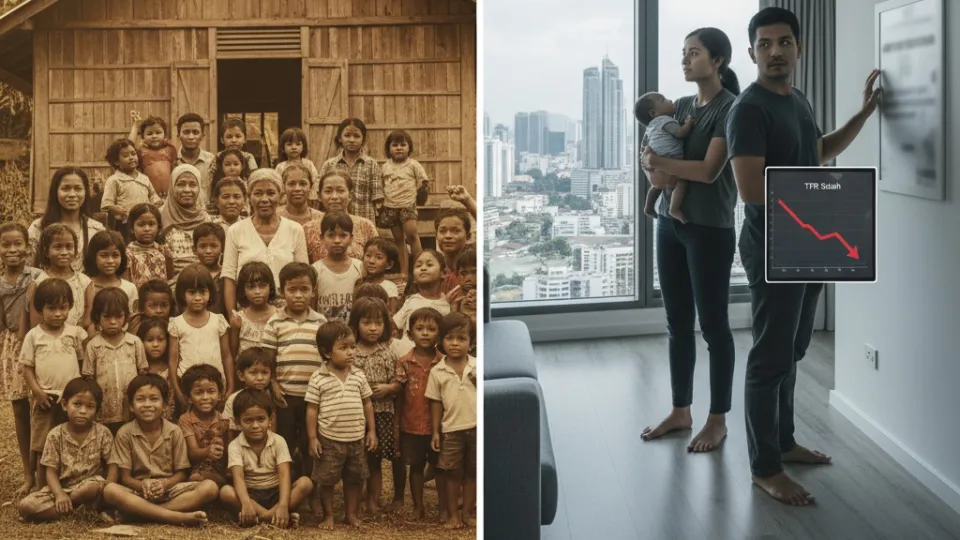
SABAH's demographic shift is a stark trend that many see as a direct reflection of deep-seated economic injustice. This has been a dramatic reversal over 40 years, reshaping Sabah's social and economic foundation.
The story of this shift is best told through the Total Fertility Rate (TFR), or the average number of children a woman is expected to have. In the 1980s, Sabah was a youthful state, but this has changed dramatically. The decade of the 2010s was the critical turning point, with the TFR dipping below the 2.1 replacement level needed to maintain a stable population.
The nation's top statistician, Dato' Sri Dr. Mohd Uzir Mahidin, has specifically highlighted this rapid change.
“Sabah recorded the fastest-declining TFR, with 5.5 children in 1980 and 1.4 children in 2022,” said Dr. Mohd Uzir Mahidin, the Chief Statistician of Malaysia.
This statistical collapse is rooted in real-world economics. It is driven by two main factors. First, a significant "brain drain" of young, educated Sabahans who must leave the state for better job opportunities in Peninsular Malaysia or overseas. For many, this "brain drain" is a necessity. Second, for those who stay, the high cost of living, coupled with lower wages and unreliable infrastructure, is a major factor. A married couple in Kota Kinabalu, for example, might look at the cost of housing, childcare, and education and decide to have only one child, or none at all. These are seen as a logical response to an economy starved of its development funds.
This demographic reversal is creating a new challenge that was once unthinkable for Sabah: an ageing population.
As data from the Population and Housing Census of Malaysia 2020 confirms, the state's median age is climbing, reflecting this new reality.
This is why the demographic data is now so politically charged. This challenging outlook is seen by many as a direct symptom of economic injustice, particularly the federal government's failure to return the 40% federal revenue entitlement as outlined in the Malaysia Agreement 1963.
There is a growing belief that this trend is reversible by treating the root cause. The hope tied to the 40% federal revenue entitlement is crucial. Many believe that if this revenue is fully materialised, it would provide Sabah with the financial power to finally change its economic landscape. This new funding could create high-value jobs and build reliable infrastructure.
The hope is that with this economic justice, the "brain drain" will reverse, with Sabahans moving back home rather than out, and that a stable, prosperous economy will give young couples the confidence to start growing their families once again.