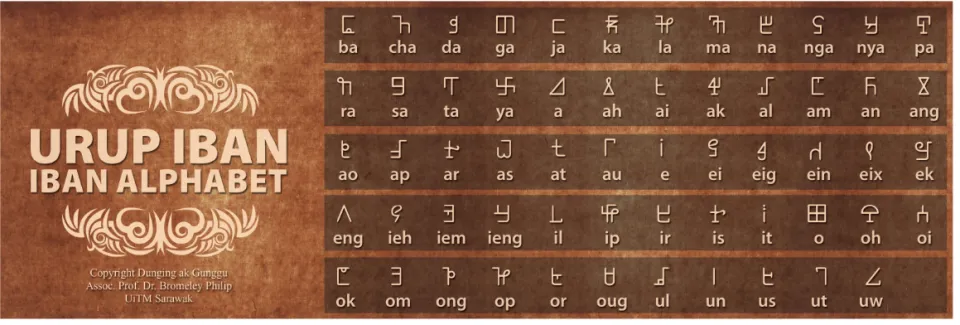
The Dayak people in Borneo face a significant challenge. Their numerous languages and dialects exist on a spectrum of written representation. Some have their own writing systems, while others rely on adapted Arabic or Latin alphabets. But a significant portion of Dayak languages lack any formal writing system at all, relying solely on oral tradition passed down through generations. This lack of a unified written form hinders communication and creates a barrier to feeling connected across Dayak communities. More importantly, it can leave smaller Dayak subgroups vulnerable to marginalisation and even forced assimilation.
Existing Writing Systems and the Need for Unification
It's important to acknowledge that some dominant Dayak subgroups, like the KadazanDusun and Iban, have ongoing efforts to expand and developed writing systems using modified Latin alphabets. These scripts have been instrumental in documenting and preserving these specific Dayak languages. However, these writing systems, while valuable, still face some limitations.
The existing scripts for individual Dayak dialects are not readily interchangeable among subgroups. Someone familiar with the KadazanDusun writing system, for example, would likely struggle to understand written text in Iban or other Dayak dialects, e.g. “Kaamatan” and “Gawai” both mean Harvest Festival; “Onsoi” and “Mansiu” both mean “Good”. Even within specific Dayak languages, there can be variations in how the modified Latin alphabets are used, like “Kaa’matan” and “Kaamatan”. This inconsistency can further hinder communication and make it difficult to develop educational resources.
Therefore, while existing writing systems play a crucial role, a unified system that caters to the broader Dayak community could offer significant advantages.
Scripts Meanings rather than Sounds
Chinese language, on the other hand, offers an interesting example. Despite numerous dialects like Hakka, Hokkien and Fuchow, written Chinese characters (漢字) bridge the gap. 漢字 represents meaning, not sound, allowing people to understand written text even if spoken dialects differ greatly. For instance, the same 漢字 character can be read and understood in Cantonese or Mandarin, despite their distinct pronunciations. E.g. "吃飯" means "having a meal" in Chinese but can be read differently as "seed fun" (Hakka), "jiak beng" (Hokkien), "sheak boun" (Fuchow) , "hek faan" (Cantonese), "chi fan" (Mandarine). Suprisingly, the same characters "吃飯" can also be read as "xơi cơm", "ăn cơm" and "dùng cơm" in Vietnamese dialects; it also read as "kitsupan" in Japanese, "heulban" in Korea but with slightly deferent meaning.
Could the Dayak people benefit from a similar approach? Perhaps a unique writing system, inspired by 漢字, could be developed. This system could utilise familiar Latin letters but incorporate special symbols for common words shared across Dayak dialects. It could also be written with a whole new symbol / character set.
The advantages of a unified writing system extend far beyond improved communication. It could foster a stronger sense of unity among Dayak communities, promoting cultural exchange and shared identity. This, in turn, could help protect smaller Dayak subgroups from marginalisation or even attempts at forced assimilation by dominant groups. A unified writing system can empower the Dayak people to preserve their unique linguistic heritage and strengthen their collective voice.
Building a Script for Unity
While the idea is promising, creating such a writing system requires careful planning and collaboration. Here's where a dedicated linguistic council comes in. Envisioned as a collaborative body of language experts, community leaders, and educators, this council would spearhead the development process.
It's important to remember that languages, like cultures, evolve over time. The remarkable Hanzi system wasn't created overnight; it's a product of over 4,000 years of refinement. The Dayak unified writing system would need a similar long-term vision. The council would meticulously study Dayak languages, identify commonalities, and gradually develop a writing system that caters to the specific needs of the diverse Dayak communities.
Community Engagement is Key
The success of this endeavour hinges on community acceptance. The council would need to actively engage with Dayak communities throughout the process. Open discussions, feedback mechanisms, and education initiatives would be crucial for gaining community buy-in and ensuring the new writing system reflects and respects the rich history of Dayak languages.
Another Example of Universality in Writing Systems
Interestingly, even beyond meaning-based systems like Hanzi, there are examples of characters with near-universal recognition. Look at the Arabic numerals (0, 1, 2, 3, etc.). Despite vast differences in spoken languages, these symbols are understood and used worldwide. Perhaps some inspiration for commonly used numbers or symbols could be drawn from existing, universally recognised systems.
Conclusion
A unified writing system for Dayak languages presents a potential pathway for stronger communication, cultural exchange, and language preservation. By establishing a linguistic council, adopting a long-term approach, and considering the universality of certain characters, the Dayak people can embark on a journey to create a script that fosters unity while celebrating their linguistic diversity. A unified writing system can be a powerful tool for promoting cultural unity and self-determination, strengthening the Dayak people's ability to resist assimilation, even among subgroups.