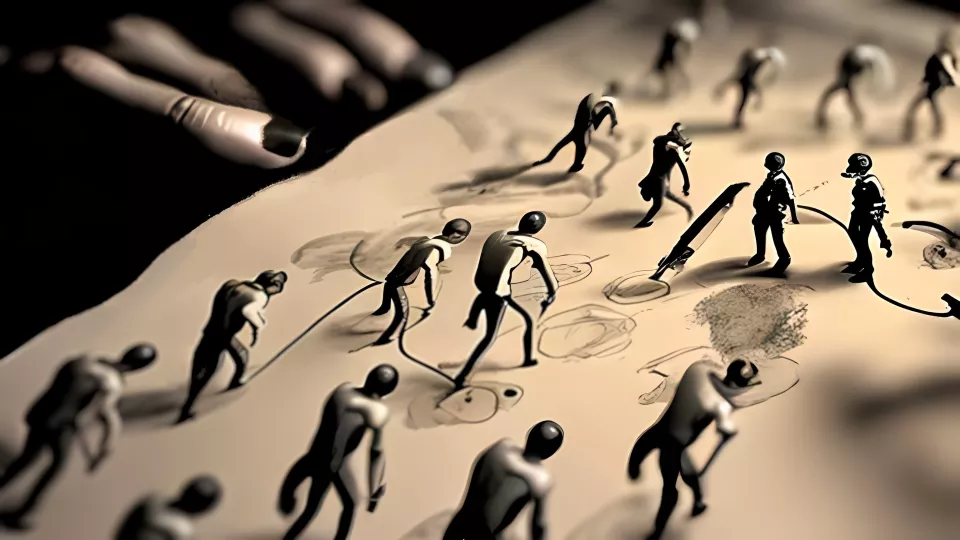
In the ever-evolving digital landscape, where the fusion of technology and creativity continuously reshapes our understanding of innovation, a discourse that challenges the very essence of ownership in the age of AI.
Our stance must be clear and resolute: copyright belongs firmly to the prompt provider. We assert that AI, for all its intelligence and efficiency, remains a tool, not an originator of content.
Imagine this scenario: You're the visionary, the narrative sculptor, the mastermind behind a creative concept. With fervour, you provide the prompt, a guiding beacon steering AI toward manifesting your artistic vision.
Artificial Intelligence or AI, the remarkable instrument that takes your prompt and executes its enchanting wizardry. It breathes words, births images, composes melodies, or even assists in creating articles like the one you are reading right now, based on extensive directives. But at its very core, AI lacks independent ideas, dreams, or inspirations; it stands as a studio with canvas, brushes and colours awaiting your orchestration.
Within this realm of creative partnership, AI is a facilitator, a vehicle that magnifies your artistic prowess. It is not the originator; it's the collaborator, the tool. It equates to a typewriter, proficient at transcribing your words but devoid of ownership over the narrative. It's akin to a camera, adept at capturing your vision but not claiming authority over any image produced.
Now, let's pivot to copyright. Its essence is to safeguard creators, those who birth innovation into existence. In our digital age, we confront a fundamental question: Who truly constitutes the creator when AI plays a role? The answer is unequivocal - it is you, the prompt provider.
Envision a scenario where AI akin to Thor's Hammer, Mjölnir, stands as a powerful tool. It possesses incredible potential and capabilities, but it requires a skilled wielder to unlock its full potential. Much like the wielder of Mjölnir harnesses the mighty power of the God of Thunder, the prompt provider wields AI as a creative instrument. AI may facilitate content generation, but it is the prompt provider who assumes the role of the visionary architect, shaping destinies and forging creative legends within the digital landscape.
However, it is essential to recognise the creators or trainers of these AI, the artisans who forge these digital marvels. They are humans, too, navigating the ever-shifting currents of innovation in pursuit of their livelihoods. These individuals invest their expertise and time into crafting these useful tools that amplify our creative capacities. In doing so, they deserve their fair share of recognition and compensation, of course, separate from the copyright.
While we celebrate the wielders of creative power, we must also honour the tool makers, for they are the blacksmiths who imbue the hammer with its strength, to assist its wielders achieve what is intended.
In the grand panorama of this debate, the confluence of AI and copyright should inherently make sense. Copyright firmly belongs to the prompt provider because AI stands as nothing more than a sophisticated instrument, and the prompt provider infuses content with their ideas, viewpoints, and creative essence.
On the other remark, the advancement of AI technology might bring the emergence of plagiarism-fighting mechanisms, where the originality of the prompt itself could be verified.
As we conclude, let's celebrate the digital age and the exceptional tools it grants us. AI stands as a blessing, an exquisite instrument that amplifies creativity. However, it should never overshadow the true creators – the prompt providers. Copyright, in its rightful essence, belongs to those who infuse life into the final works, employing AI as a reliable tool to carve the landscape of ingenuity. In this narrative, the champions are the wielders, and the craftsmen who shape these tools deserve their well-earned share of recognition, for each plays a pivotal role in the symphony of innovation.